
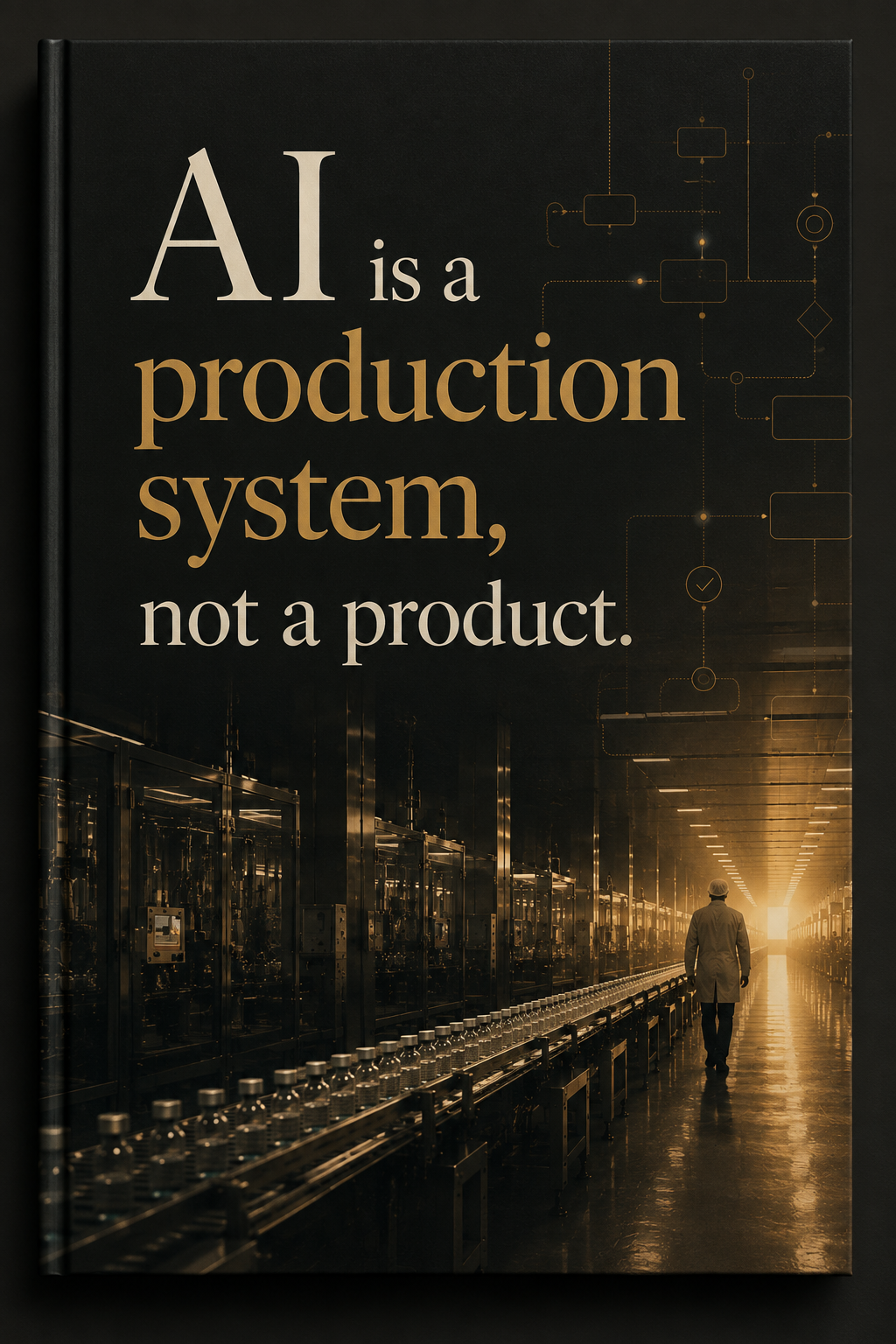
The book
AI is a production system, not a product.
The market keeps pitching AI as a product you adopt. Pick a model, buy a tool, switch it on. That framing is wrong, and it is wrong in ways that matter most exactly where AI most needs to work, in regulated industries where being wrong has a price.
The argument of this book is simple. The value in AI does not sit in the model. It sits in the production system around it. Three layers, each load-bearing.
The first layer is physical. Compute, power, grids, sovereignty. The frontier of AI runs on a supply chain that is already constrained, and most organisations have not priced in what that means for the systems they are buying.
The second layer is accountability. In a probabilistic system in a regulated setting, someone has to own the output. That responsibility cannot be outsourced, merged away, or delegated to the vendor. It is a discipline, and like every discipline it is expensive in places the accounting does not name.
The third layer is the work itself. What adoption actually looks like inside a pharmaceutical company, in medical affairs, in market access, in promotional review. Decoded for the people doing the work, not for the people pitching it.
The book is being written in public, one essay at a time, from inside real projects. The essays on this site are the working draft. If you want the chapters as they are written, the email list is how they land.
The argument
Three load-bearing layers
Compute, the strategic substrate
Compute is where AI work happens: the chips, the data centres, the power that keeps them cool, the network that gets work to and from them. Most enterprises treat it as a procurement problem, billed to IT, optimised for unit cost. The operators who pull ahead over the next five years treat it as a strategic asset, accountable to the strategy line, optimised for resilience and option value.
It is the same decision any operations executive recognises from manufacturing: where do you produce, on whose terms, with what dependencies, and at what risk if the conditions change. A factory in the wrong country with a single supplier is a vulnerability dressed as efficiency. A compute strategy locked into a single hyperscaler with no exit plan is the same vulnerability with a different vendor logo.
The companies that get Compute right treat it as a portfolio: multiple providers, deliberate geographic spread, an honest view of where sovereignty matters and where it doesn't, and a price model that survives a vendor's next pricing review.
Data, inputs as a supply chain
Data is the raw material. Not a strategic theme, not a transformation slogan, not a slide in the board pack. A production input with a supply chain, the same as any other raw material a serious operation depends on.
That means it has provenance (where it came from, who owns it, on what terms you can use it), quality (measurable, not assumed), rights (training, usage, redistribution, and whether you actually hold them), and lineage (the audit trail from origin to model).
The companies that get Data right run it like a supply chain: specifications for inputs, contracts with suppliers, quality control on incoming material, and a way to swap a supplier without rebuilding the line. The companies that get it wrong build sophisticated models on inputs they don't fully own, control, or trust, and find out at the worst possible moment.
Process, where humans meet the system
Process is the operating layer, where the technology meets human judgement, organisational authority, and accountability for what gets done. It is not a wrapper around the technology, not change management, not the last chapter of the strategy deck. It is the layer that determines whether the technology can be deployed at all. Three things hold it together.
Permission
Permission is the licence to deploy: who approves, who can stop the line, who carries the risk, who explains it to the outside world. Most AI programmes assume permission, build the model, deploy it, and hope nobody asks. The day someone does, the absence of an answer is the failure.
Practice
Practice is the standard operating procedure: how the work is done, by whom, on what schedule, with what controls. Borrow the andon cord: any operator, regardless of seniority, has the authority to stop the line when something looks wrong. Most enterprise AI has no andon cord, and most leaders would be surprised how often it would get pulled.
Proof
Proof is the evidence trail, that the system did what it was meant to do, when it was meant to, with the inputs it was meant to have, for the people it was meant to serve. Without it, Permission cannot be defended and Practice cannot be evidenced. It is also the layer that pays back most quietly: organisations that build Proof from day one find their next pilot, their next deployment, and their next regulator conversation all go easier.
The framework, interactive
A three-layer framework. Top layer: Process, where humans meet the system, containing Permission, Practice, and Proof. Middle layer: Data, treated as a supply chain. Bottom layer: Compute, the strategic substrate.
The newsletter
Get the chapters as they are written.
Free for now. One essay at a time, sent when it is ready. No spam, unsubscribe anytime.
Who it is for: commercial, digital and data leaders in pharma and life sciences who are past the hype and need to make real decisions with real money behind them. And the operators inside those organisations who have to ship the work.
The chapters
How this book was made
This book was built in public. It began as a twelve-week LinkedIn series in 2026, and its chapters were published here one at a time as they were drafted, then revised as the evidence moved. Over that period the work was seen 36 per cent more often than in the months before, and nearly three quarters of those views came from people outside my own network. The book was drafted with Claude, a model made by Anthropic, working under my direction: the framework, the argument, the cases and every editorial decision are mine, and every figure is sourced at the foot of its chapter, with commercial interests stated. A book that argues AI should be run as a production system ought to be able to say how it was produced. This one can, and the named owner is me.
Part one: Compute
Part two: Data
Part three: Process
Part four: Accountability
Get the book first
Register and you will be the first to know when the full book is available.