
Decoding AI
FDA + EMA regulator AI moves
Decoding AI — two regulators, two different bets, and an uncomfortable implication for pharma boards still arguing about their own AI governance.
Two regulator stories landed in the past six weeks, and the symmetry is worth digging into.
Two regulator stories landed in the past six weeks, and the symmetry is worth digging into.
On 28 April, the FDA announced real-time clinical trial pilots with Amgen and AstraZeneca. Live cloud feeds of safety signals and efficacy endpoints, replacing periodic sponsor submissions. The FDA's Chief AI Officer estimates a 20-40% reduction in overall trial time. A Federal Register RFI is open now, with a broader pilot programme due this summer.
In March, the EMA extended its AI-powered Scientific Explorer tool to marketing authorisation reviews. Assessors at EMA and the national competent authorities can now mine prior decisions, public assessment reports, and regulatory precedent at speed. Faster reviews, more consistency, and a sharper benchmark for every submission against everything that came before it.
Two regulators, two different bets. The FDA is using AI to compress the timeline. The EMA is using AI to deepen the scrutiny. Both are getting comfortable with AI in the regulatory workflow faster than most pharma companies are getting comfortable with AI in their own.
The implication for pharma leaders is uncomfortable but clear. You will be regulated by AI-augmented regulators before you have finished arguing about your own AI governance.
The first wave of accelerated approval pathways will favour sponsors who can plug into real-time data sharing. The next wave of EMA reviews will benchmark your submission against decades of precedent in seconds.
The question is no longer whether to engage. It is how fast you can co-design.
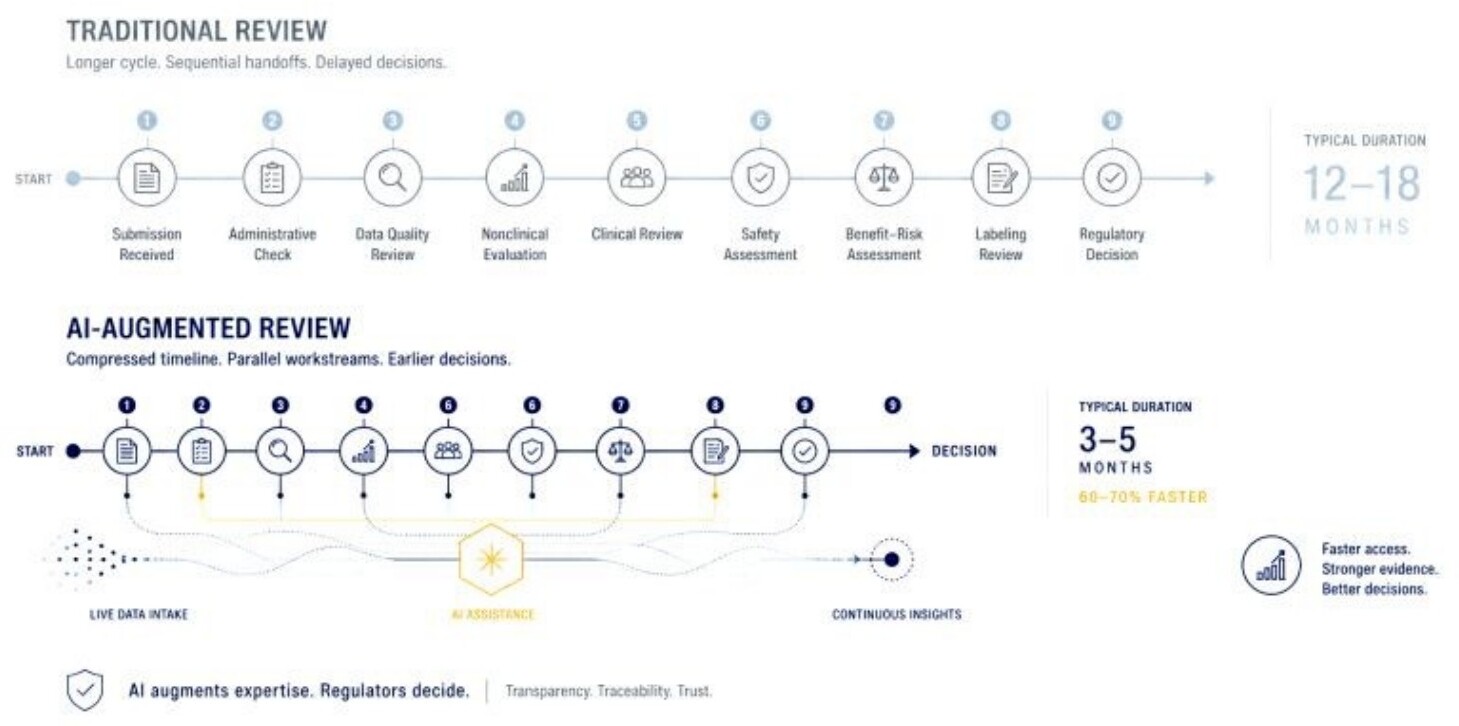
| Traditional review | AI-augmented review | |
|---|---|---|
| Cycle | Longer cycle. Sequential handoffs. Delayed decisions. | Compressed timeline. Parallel workstreams. Earlier decisions. |
| Typical duration | 12–18 months | 3–5 months (60–70% faster) |
| Workflow | Submission → admin check → data quality → nonclinical → clinical → safety → benefit-risk → labeling → decision, in sequence. | Same nine steps, run in parallel with live data intake, AI assistance, and continuous insights feeding the panel. |
| Operating principle | Periodic sponsor submissions reviewed in batches. | AI augments expertise. Regulators decide. Transparency, traceability, trust. |
| Outcome | Delayed access. Evidence frozen at submission. | Faster access. Stronger evidence. Better decisions. |