
Layer · Process · Practice
The 350 engineers Ford could not prompt
Ford rehired 350 veteran engineers after its AI quality system fell short. The story is not about the AI. It is about Practice — the discipline of running AI inside the work, with named people who correct it and corrections that feed back.
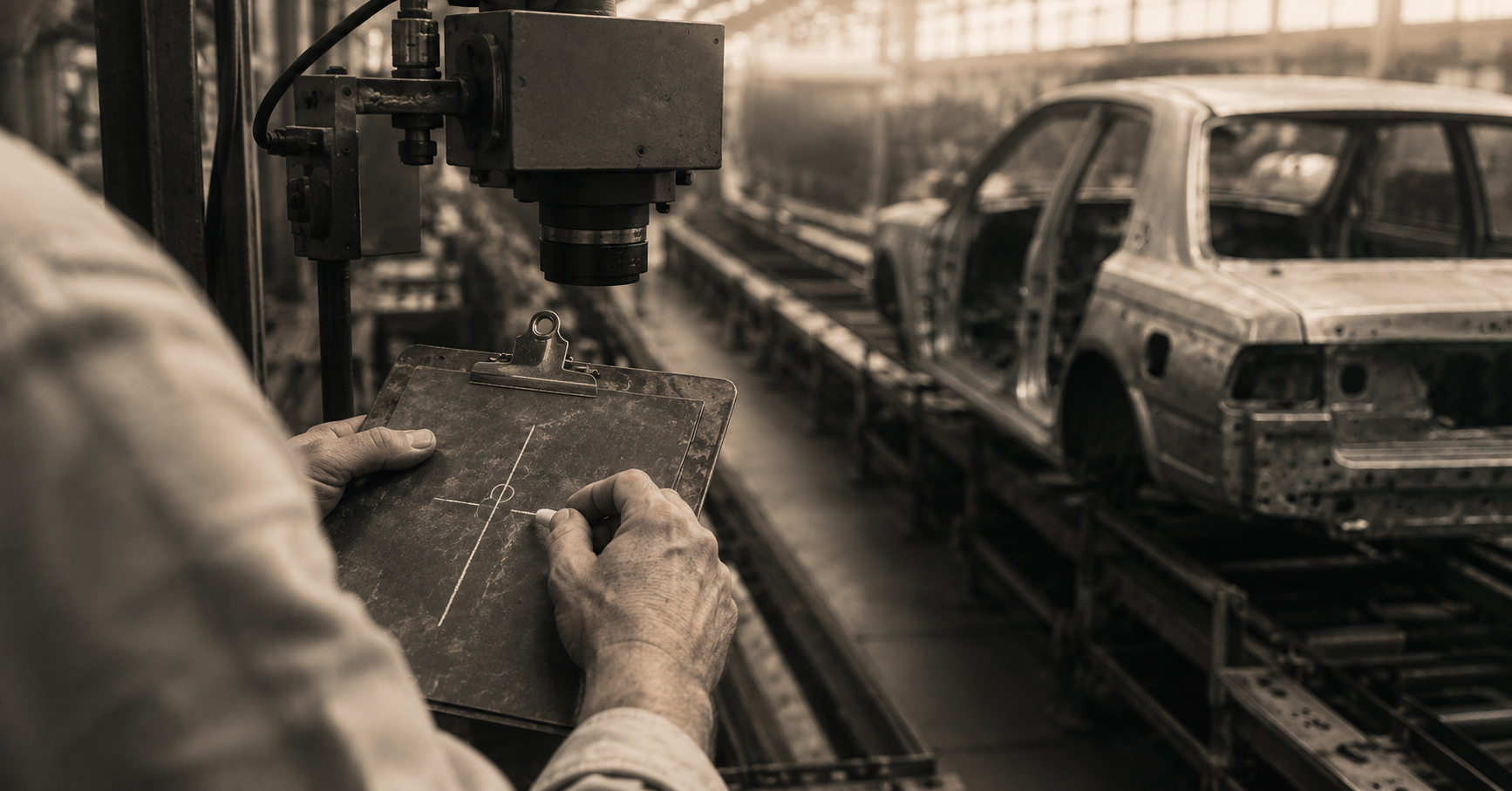
In June, Ford confirmed it had rehired 350 veteran engineers, a number of them lured back from retirement, after the AI it installed to police build quality fell short. The cameras could see the defects. They could not tell which ones mattered.
In June, Ford confirmed it had rehired 350 veteran engineers, a number of them lured back from retirement, after the AI it installed to police build quality fell short. The company had deployed 900 AI-powered cameras across its production lines. It had, in the words of Charles Poon, its vice president of vehicle hardware engineering, assumed that ingesting the design requirements would be enough to produce a high-quality product.
It was not. The cameras could see the defects. They could not tell which ones mattered, because the judgement of the people who had lived through the recalls and the warranty claims had never been written down. Institutional knowledge, it turns out, does not compress into a prompt.
What Ford did next is the actual story, and it is why this piece sits in the Process layer of the framework rather than the Data layer. Ford kept the cameras. It set the returning engineers to work training younger staff and reprogramming the AI tools, so that every correction a human made became an input the system learned from. Jim Farley now puts the value of the quality push in the hundreds of millions of dollars, mostly in warranty and recall costs that never happened, and Ford this year took the top mainstream position in the JD Power Initial Quality Survey.
That loop, the system runs, a named person corrects it, the correction feeds back, is Practice. It is the second of the three Ps that make up the Process layer, sitting between Permission, which decides what the system may touch, and Proof, which decides how you demonstrate the whole thing works to the people who carry the liability.
Practice is where most AI programmes quietly die, because it is the unglamorous part. It is rotas and escalation paths and the question of who owns the output at 2am. This article sets out what disciplined practice looks like, why the firms doing it are hiring rather than cutting, and what a plant in Toyota City understood about it forty years ago.
What practice actually is
Strip the word of its gym connotations. Practice, in this framework, is the standing arrangement by which an AI system and the people around it do the work together, day after day, and get better at it. It has three observable properties, and you can audit any deployment against them in an afternoon.
First, the system runs inside the work, not beside it. A model that sits in a separate tab, consulted when someone remembers it exists, is a pilot wearing a lanyard. Ford's cameras were bolted above the line itself, which is why their failure was visible within weeks rather than buried in a quarterly review.
Second, named people correct it. Not a committee, not a centre of excellence, a rota of individuals whose job description includes overriding the system and who are senior enough for the override to stick. Ford's insight was that the correcting is a skill in its own right, and one that lived in engineers it had let retire. The correction is the expensive part, which is precisely why it is valuable.
Third, the corrections go somewhere. An override that dies in a log file is a cost. An override that becomes a labelled example, a revised threshold, a rewritten prompt, is an asset. This is the difference between using AI and running it, and it is the property most programmes cannot demonstrate when asked.
None of this is glamorous. That is rather the point. Toyota's advantage in 1985 was not a technology the competition lacked, every carmaker could buy robots, it was a set of habits about who touched the line, when, and what happened to what they learned.
The evidence that practice compounds
If practice were merely hygiene, you would expect firms that invest heavily in AI to shed people as the systems bed in. The opposite is showing up in the spending data.
Ramp and Revelio Labs matched firm-level AI spending against workforce records for more than 21,000 US companies. The firms in the top third of per-employee AI spend, roughly $30 per employee per month in the first three months, grew headcount 10.2 per cent over the two years following adoption. Entry-level roles grew faster still, up 12 per cent. And the two qualifications matter more than the headline. The gains appeared only among high-intensity adopters, and they did not appear at all for six to twelve months.
Read those two conditions together and they describe practice. Light use produces nothing measurable. Sustained, high-intensity use produces growth, but only after the loop has had time to turn: systems corrected, corrections absorbed, work redesigned around what the system can now be trusted to do. The lag is not friction. The lag is the learning.
The counterexamples land the same lesson from the other side. Mark Zuckerberg told his own staff this month that Meta's agents have not progressed as quickly as he had hoped, a company with effectively unlimited compute and frontier models of its own. Capability was never the binding constraint. The loop was.
The land-grab for other people's practice
The suppliers have read the same data, and their spending tells you what they concluded.
In the span of a week, Amazon put $1bn into a forward-deployed engineering organisation that embeds its people inside customers' operations, following the playbook OpenAI and Anthropic had already adopted. Microsoft went further, committing $2.5bn and 6,000 employees to a dedicated implementation unit. These are not sales teams. They are practice mercenaries, rented loops for firms that have not built their own.
It is worth pausing on what this means competitively. When the vendors themselves price implementation above capability, they are conceding that the model is becoming the commodity and the practice is becoming the product. A firm that rents its practice loop from its supplier should ask who owns the learning the loop produces, because the corrections its people make are the most valuable training data in the building. That question belongs to the lock-in seam of this framework, and it deserves its own essay. For now, note only that the invoice for someone else's practice arrives monthly, and compounds against you.
The national version of the same deficit is visible in the reskilling numbers. Ibec's report this month found 64 per cent of Irish roles need significant reskilling for the age of AI, with €96bn of GDP resting on whether the technology is used to cut cost or to unlock higher-value work. Training courses alone will not close that gap, for the same reason Ford's design requirements did not. Skill that is not exercised inside the work decays into a certificate.
Practice in regulated work
In regulated sectors the loop acquires a signature. A pharmaceutical batch record reviewed with AI assistance still carries a named person's sign-off, and the US Food and Drug Administration has been clear, in inspection after inspection, that the name on the warning letter is human whatever ran the workflow. Some read that as a brake on adoption. It is better read as a specification. The regulator is describing a well-built practice loop: a system that runs inside the work, a named person accountable for correcting it, and a record of what the correction was.
Which is why the firms treating sign-off as an integrity mechanism, rather than a compliance tax, are the ones finding that regulated work is where AI pays soonest.
The correction is already staffed, already documented, already habitual. The loop was there before the model arrived.
How you demonstrate that loop to a board, an auditor or an inspector is Friday's question. That is Proof, the third P.
The line Toyota drew
Toyota in 1985 did not have the best robots. General Motors had more automation and spent more money on it. Toyota had the andon cord, the plain cloth rope above the line that any worker could pull to stop production, and a standing rule that what stopped the line had to change the line.
That is the whole of Practice, stated forty years early. The tool runs inside the work. A named person can override it. The override changes the system. Everything else in this essay is elaboration.
The AI winners of the next decade will not be the firms with the largest models or the boldest pilots. They will be the ones that made correction a job, gave it to people with judgement, and wired what those people learned back into the machine. Ford just paid 350 salaries to relearn this. The rest of us can read the invoice.
Sources
- Ford's rehiring of 350 veteran quality engineers and the results — Bloomberg, 25 June 2026: https://www.bloomberg.com/news/articles/2026-06-25/ford-has-been-rehiring-quality-inspectors-after-ai-fell-short
- Ford rehires gray-beard engineers after AI falls short — TechCrunch, 28 June 2026: https://techcrunch.com/2026/06/28/ford-rehires-gray-beard-engineers-after-ai-falls-short/
- Ramp x Revelio Labs firm-level study: 21,000+ US firms, headcount up 10.2% among high-intensity adopters, entry-level up 12%: https://ramp.com/data/ai-jobs-impact
- Microsoft's $2.5bn, 6,000-person AI implementation unit — CNBC, 2 July 2026: https://www.cnbc.com/2026/07/02/microsoft-commits-2point5-billion-6000-employees-ai-implementation-unit.html
- Amazon's $1bn forward-deployed engineering organisation — TechCrunch, 30 June 2026: https://techcrunch.com/2026/06/30/amazon-launches-new-1-billion-fde-org-following-openai-and-anthropic/
- Ibec, Skills for all, skills for life (July 2026): 64% of Irish roles need significant reskilling, €96bn of GDP at stake: https://cdn.ibec.ie/-/media/documents/skills-for-all-skills-for-life.pdf