
Series · Physical Layer of AI - Part 1
Compute is not the new oil. It is harder to replace.
The Physical Layer of AI, Part 1 — the moment AI stops being a software story and becomes an industrial one.
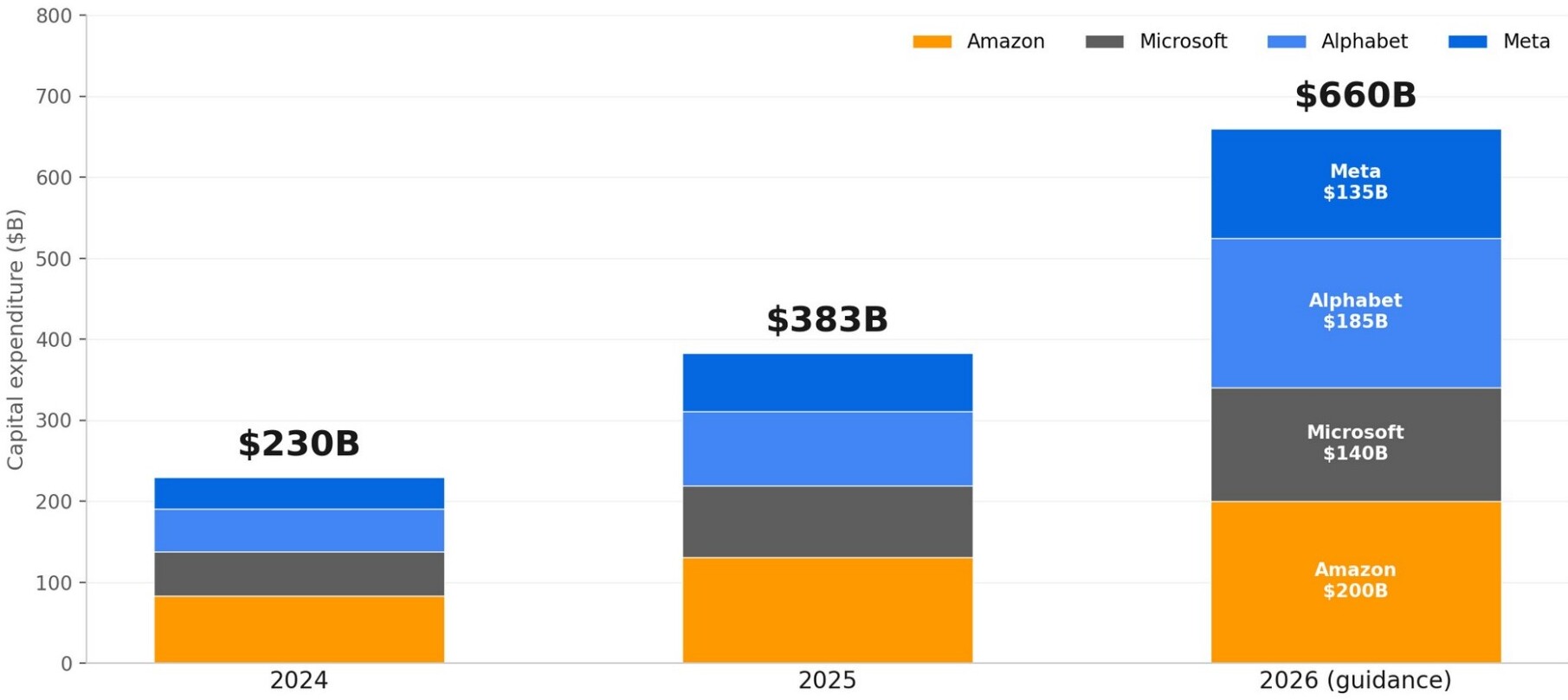
Between them, Amazon, Alphabet, Microsoft and Meta have committed to between $660 billion and $730 billion of capital expenditure in 2026. That is more than four times what the entire publicly traded US energy sector spends each year on drilling, refining, distributing fuel and running petrochemical plants combined.
Most of that money will not buy software. It will buy buildings, chips, transformers, cooling plant, and the gas turbines or grid contracts to power them.
This is the moment AI stops being a software story and becomes an industrial one. And it is the moment the people responsible for AI deployment in pharma, life sciences, and other regulated sectors need to look up from the model layer and start understanding the physical layer beneath it.
The money in
The numbers are public, and they are sharper than they were three months ago. Amazon plans $200 billion of capex in 2026, up from $131 billion in 2025, with Andy Jassy confirming that the spend will be predominantly in AWS. Alphabet raised its 2026 guidance again yesterday, to between $180 billion and $190 billion, with CFO Anat Ashkenazi telling investors that 2027 will be "significantly higher" still. Microsoft is on a similar trajectory, with $34.9 billion in Q1, $37.5 billion in Q2, and $31.9 billion in Q3 of FY26, two-thirds of which has gone to short-lived assets, primarily GPUs and CPUs. Meta raised its 2026 guidance the same day Alphabet did, from $115-135 billion to $125-145 billion. Goldman Sachs now models more than $1.15 trillion in aggregate hyperscaler capex across 2025, 2026, and 2027 combined.
These are not aspirational numbers. They are signed contracts and disclosed commitments. And they have already moved through the supply chain to the equipment vendors.
Nvidia takes the headline. The constraint sits one layer below.
Nvidia's scale defies comparison: $215.9 billion in revenue for fiscal 2026, up 65% year on year, of which $193.7 billion was the Data Center segment. In the most recent quarter alone, Q4 ending 25 January 2026, Nvidia booked $68.1 billion in revenue and $43 billion in net income. Hyperscalers account for more than half of its data centre business. Its sovereign AI line item, governments buying compute for national use, tripled to over $30 billion in a single fiscal year.
But the binding constraint is no longer at Nvidia. Look at the layer below.
TSMC's 2nm node, where the next generation of AI accelerators are made, has lead times stretching to 78 to 104 weeks, with new orders pushing into 2028. The advanced packaging that bonds those chips to memory, called CoWoS, is sold out through mid-2026, with TSMC racing to lift capacity from around 35,000 wafers per month at the end of 2024 to 130,000 by late 2026. Nvidia alone has locked roughly half of TSMC's CoWoS capacity. SK Hynix, which supplies somewhere between 57% and 62% of the world's high-bandwidth memory, has stated publicly that its entire 2026 HBM output is already allocated, and its operating margin in Q1 2026 reached 71.8%, a level no memory company has recorded in history. ASML, the only company in the world that makes the EUV lithography systems on which all of this depends, raised its 2026 revenue guidance to between €36 and €40 billion in April.
This is what an industrial supply chain under stress looks like. It is not a software bottleneck.
The ground is shifting beneath Nvidia
Broadcom reported Q1 FY26 AI revenue of $8.4 billion, up 106% year on year, and its CEO has stated publicly that the company has "clear line of sight" to over $100 billion in annual AI chip revenue by 2027. Most of that comes from custom accelerators designed in partnership with Google (TPUs), Meta (MTIA), AWS (Trainium), and most recently OpenAI, which has committed to deploying 10 gigawatts of Broadcom-co-developed silicon. Anthropic alone has signed for around 3.5 gigawatts of custom TPU capacity through Broadcom from 2027.
What the market called "the AI chip wars" was always more accurately a question of who would be permitted, by capital, by physics, and by lithography slots, to build at scale. Broadcom answered first. Others will follow.
What this means if you are running an AI programme inside a regulated business
The familiar diversification story, that we can move workloads from Azure to AWS to Google Cloud if vendor risk gets too concentrated, has always been overstated. In 2026 it does not really exist. The HBM is allocated. The CoWoS is locked. The 2nm wafer slots are committed. The GPUs your provider runs you on will not exist at scale anywhere else for eighteen months.
Your vendor concentration is no longer a commercial decision. It is a physical one.
For a pharma board working through a multi-year AI deployment plan under MLR, GxP, the EU AI Act, and CSRD reporting, this is the part of the picture most likely to be missing from the business case in front of them. The unit economics modelled in 2024 assumed compute would get cheaper, not constrained. The vendor risk register assumed portability that no longer exists. And the sustainability footprint, which we will get to in part six of this series, was modelled against a renewable mix that the actual 2026 power supply does not yet deliver.
The phrase "compute is the new oil" understates it. Oil has fungible global markets, twenty years of price discovery, and storage. Advanced AI compute has six chokepoints, multi-year lead times, and bilateral allocation contracts. It is closer to specialty chemicals than to crude.