
Series · Physical Layer of AI - Part 2
The grid wakes up
The Physical Layer of AI, Part 2 — what happens at the other end of the cable when hyperscaler capex meets a grid built for a 2010 world.
In December 2025, Dominion Energy disclosed that its data centre customers in Virginia have signed contracts for 48.5 gigawatts of future power — nearly twice the peak demand of the entire state.
Yesterday I argued that AI has stopped being a software story and become an industrial one, with $660 billion of hyperscaler capex chasing a supply chain that runs from Dutch lithography to Korean memory. Today the question is what happens at the other end of the cable.
In December 2025, Dominion Energy disclosed that its data centre customers in Virginia have signed contracts for 48.5 gigawatts of future power. Dominion's all-time peak load, set on a cold January morning in 2025 with the entire state's homes, factories, hospitals, schools, offices, and traffic lights running at once, was 24.7 gigawatts. The contracted data centre load is now nearly twice the peak demand of the state itself. Eighteen months earlier the same number stood at 16.5 gigawatts. The trajectory is not a forecast. It is a queue of executed agreements and engineering studies, sitting on Dominion's books.
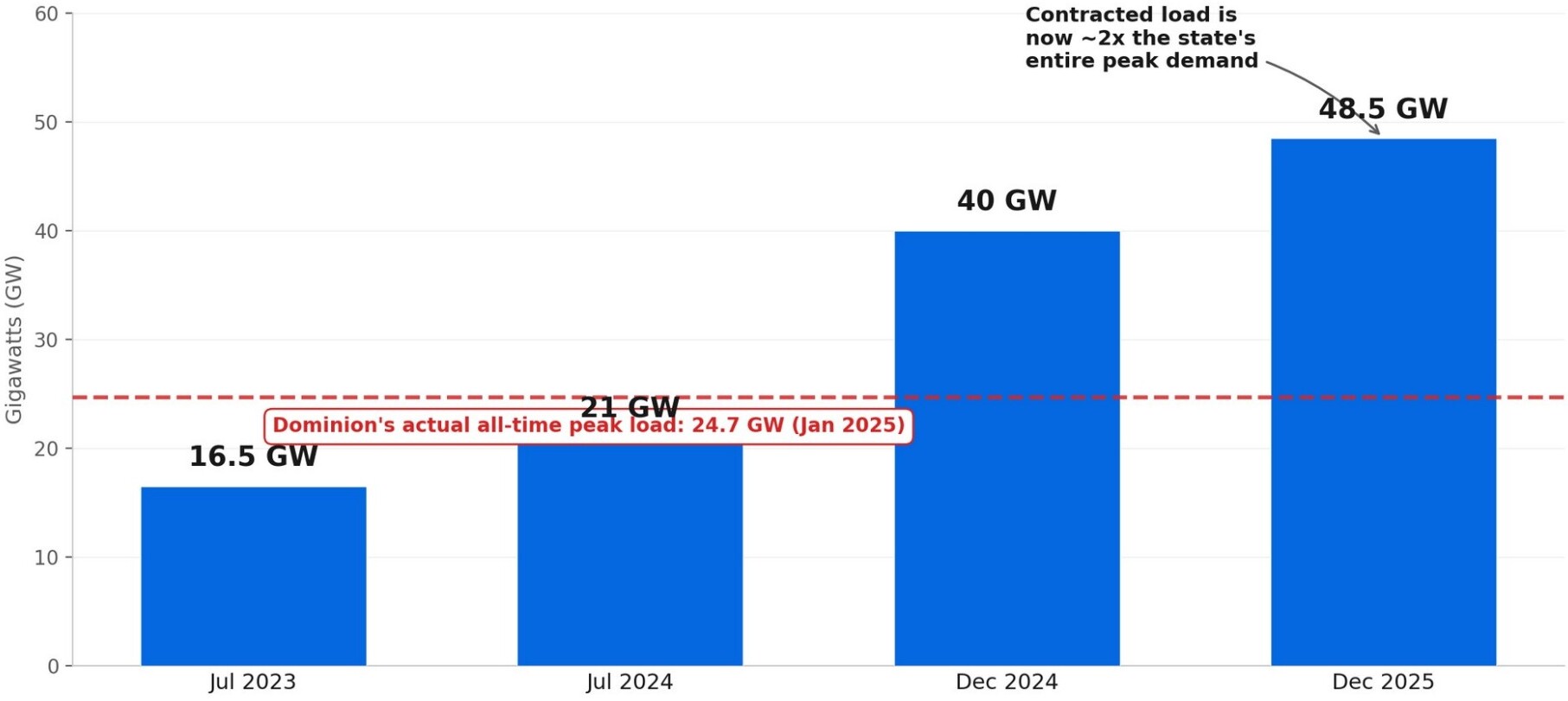
This is what the grid side of the AI buildout looks like in 2026.
The macro frame
The International Energy Agency's Energy and AI report, published in April 2025 and now the most cited primary source on the topic, projects global data centre electricity consumption rising from around 415 terawatt hours in 2024 to roughly 945 terawatt hours by 2030. That is a more than doubling in six years. In the United States, the increase is 130%. By 2030, US data centres will consume more electricity than the entire heavy industry stack of the country, more than aluminium, steel, cement, chemicals, and automotive manufacturing put together. In China, the rise is 170%. In the European Union, from around 70 terawatt hours in 2024 to 115 terawatt hours by 2030.
The pace is the headline. Data centre electricity demand is now growing roughly four times faster than total electricity demand, and the constraint has shifted from how much can be consumed to how fast it can be delivered.
Virginia is the case study, not the exception
Loudoun County, Virginia, holds 13% of global data centre capacity inside 520 square miles. Eighty-two percent of Dominion's data centre customers carry investment-grade credit ratings. The utility serves more than 450 facilities for over 50 customers, including Alphabet, Amazon, and Microsoft. And it has just raised its five-year capital plan from $50.1 billion to $64.7 billion to keep pace.
The local response is now political, not technical. In November 2025, the Virginia State Corporation Commission approved a new electricity rate class, GS-5, which from January 2027 will require large-scale data centre customers to pay for at least 85% of their contracted distribution and transmission demand and 60% of their generation demand, regardless of whether they actually use it. The trigger was straightforward. The Joint Legislative Audit and Review Commission projected that without rate-class separation, a typical residential customer's generation- and transmission-related bill could rise by between $14 and $37 per month by 2040 in real terms. The Piedmont Environmental Council estimated that under current rate structures, average residential bills would more than double by 2045, with every household paying over $2,600 per year to subsidise data centre infrastructure. PJM Interconnection's 2025-2026 capacity auction had already cleared 833% higher than the previous year, and the 2026-2027 auction hit the regulator's price cap. Virginia's energy demand is forecast to rise 183% by 2040, against 15% if data centre demand were stripped out.
The outcome is a new commercial reality. Hyperscalers in Virginia are now being asked to fund the infrastructure that serves them. Dominion is spending $50 billion of its updated capex specifically on data centre growth and clean energy transition, including a planned $1 billion super-high-voltage transmission line. The next nuclear plant, an Amazon-partnered 300 MW small modular reactor, is in pre-application. None of this will arrive before 2030.
Texas is faster, looser, and stranger
The other US epicentre is ERCOT. The Electric Reliability Council of Texas reported in April 2026 that summer 2026 peak demand will fall between 90,500 megawatts and 98,000 megawatts, already above the all-time record of 85,508 set in 2023. The longer-term forecast it filed under Senate Bill 6, which mandates large-load reporting, projected peak demand reaching 367,790 megawatts by 2032. That is more than four times today's record. The grid operator itself called the figure overinflated and said it would revise downward, but the underlying signal was clear. Of the requested capacity, around 228 gigawatts came from data centres alone. The US Energy Information Administration projects 11% annual electricity demand growth in ERCOT through 2026, against the national average of 2.2%.
Texas is the country's permissive end of the spectrum, the place where Stargate's second site is being built around a 700-megawatt off-grid microgrid of 210 industrial gas generators because plugging into ERCOT was deemed slower than not plugging in at all. Virginia is the regulated end, where the regulator is now actively rationing access. Most of the rest of the world will land somewhere between the two.
Europe is closer to this than it looks
The instinct in European boardrooms is to treat the Virginia and Texas numbers as an American problem. They are not. Ireland confirmed in June 2025 that data centres consumed 22% of all metered national electricity in 2024, with EirGrid forecasting 30% by 2032 and Brookings projecting close to 80% of local Dublin demand by 2030. Frankfurt sits at 42% of local consumption. The Commission for Regulation of Utilities in Ireland lifted its three-year Dublin moratorium in December with a substantive condition: any new data centre seeking grid connection must install on-site generation matching its full import capacity and align with an 80% renewable threshold. The European Commission's Cloud and AI Development Act, due in Q1 2026, explicitly targets tripling EU data centre capacity within five to seven years. Frankfurt, Madrid, Amsterdam, and the Nordic capitals are next in the same queue Virginia is already standing in. Article 5 of this series goes deeper into Ireland as the European test case.
The lead times that nobody can shorten
The deeper problem is that the equipment behind the grid is also constrained. Lead times for high-voltage transformers have stretched from around 50 weeks pre-pandemic to two and a half years now. Transmission cables face similar delays. Building a new high-voltage line through advanced economies takes between four and eight years from siting to energisation, before any community challenge. Gas turbines, which most US utilities now treat as the firm-capacity backstop of choice, are back-ordered at the major manufacturers into 2028 and beyond.
In 2024, a single transformer fault in Fairfax County, Virginia, caused 60 data centres to flip simultaneously to backup generation, dropping roughly 1,500 megawatts of load and nearly destabilising the regional grid. The grid the AI industry is plugging into was designed for a 2010 world of stagnant demand, and it has not been re-engineered for the load shape coming.
What this means if you are running an AI programme inside a regulated business
For a pharma or life sciences board, the operational implication is simple and uncomfortable: the location of compute now matters in ways the IT team has not had to think about before. A workload running in US-East has a different unit cost trajectory, a different carbon profile, a different Scope 3 implication, and a different regulatory exposure depending on whether the underlying data centre is being asked to fund a new 230 kilovolt transmission line or sitting on a Texas microgrid burning gas.
CSRD reporting picks up the grid mix. The next phase of vendor negotiations will pick up the rate class. And the long-running assumption that cloud capacity is fungible across regions is, for AI workloads, simply wrong.