
Series · Physical Layer of AI - Part 3
The fossil-fuel detour
The Physical Layer of AI, Part 3 — for three years the AI industry marketed itself on a clean-future story. What changed is the procurement.
Asked last year where the energy for AI should come from, Sam Altman gave a one-word answer: gas. The market agreed.
For three years the AI industry has marketed itself on a clean-future story. Carbon-neutral cloud, renewable matching, climate-positive cooling, sustainability dashboards in every annual report. The marketing has not stopped.
What changed is the procurement.
Asked last year where the energy for AI should come from, Sam Altman gave a one-word answer: gas. The market agreed. xAI's Colossus in Memphis runs on a fleet of around 35 gas turbines installed inside a year, sited next to a Black neighbourhood already adjacent to a wastewater facility, an oil refinery, and a coal plant. OpenAI's first Stargate site in Abilene, Texas, has 360 megawatts of on-site GE Vernova and Solar Turbines gas generation operating off-grid. A Louisiana utility is building three new gas plants for one Meta data centre. Across the four southern utility footprints serving Virginia, Georgia, North Carolina, and South Carolina, 20,000 megawatts of new gas generation has been proposed by 2040.
The cleanest decade of the US power mix is being interrupted by the most expensive computing buildout in history.
The turbine queue
The clearest signal is in the order books. GE Vernova, Siemens Energy, and Mitsubishi Power, the three companies that supply more than 75% of the world's large gas turbines, are all sold out for years.
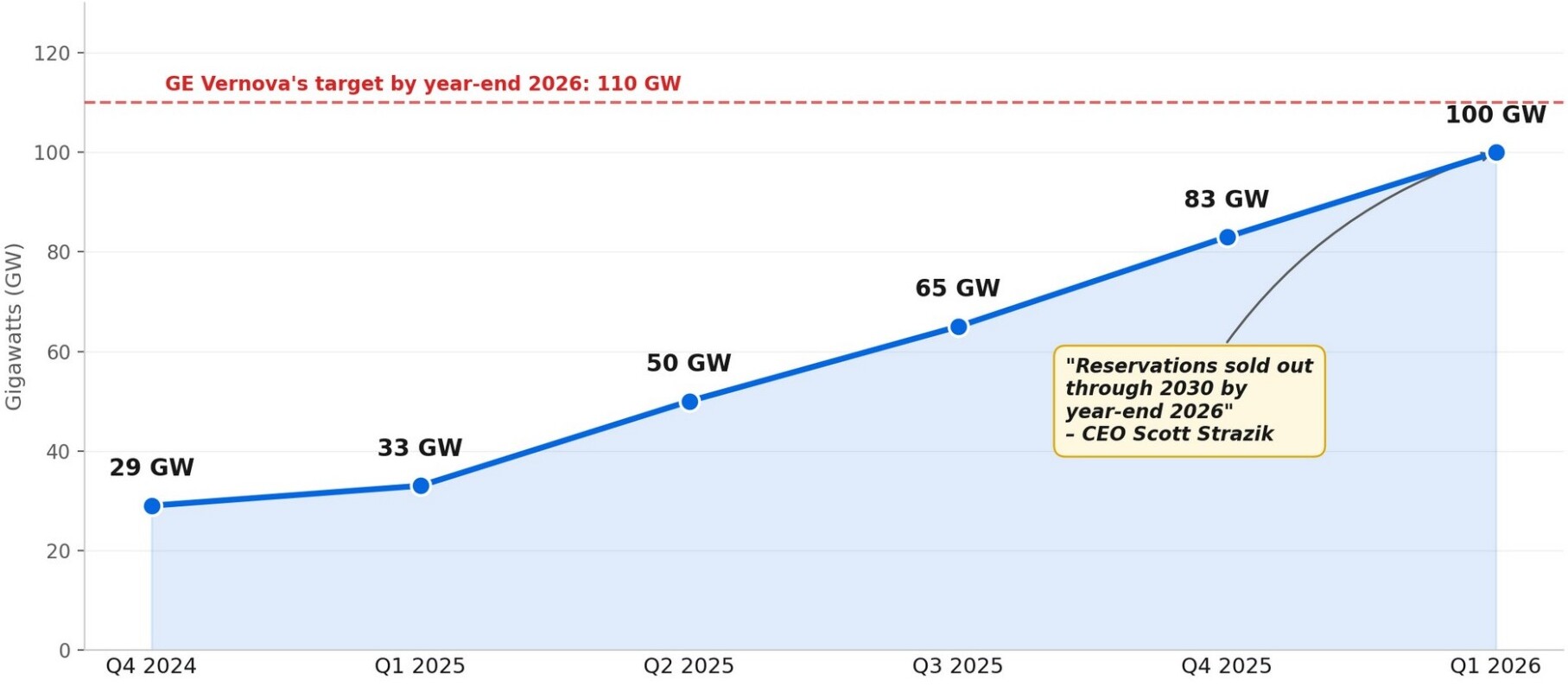
GE Vernova's gas turbine backlog reached 100 gigawatts in Q1 2026, up from 83 at the end of 2025. The CEO, Scott Strazik, told investors that turbine reservations will be sold out through 2030 by the end of this year, with the company "continuing to expect to take on orders for 2031 and beyond". Siemens Energy holds a record €131 billion order book. Mitsubishi states that turbines ordered today will not be delivered until 2028 to 2030. Wait times for delivery have stretched up to seven years in some cases, and capital costs per kilowatt have nearly tripled in two years, from $700-1000 to roughly $2,400. Developers are now paying non-refundable reservation fees of $25 million simply to hold a 2030 delivery slot.
This is not a temporary squeeze. GE Vernova's CEO said publicly in December that the company does not anticipate having to expand production capacity in the next 18 months, despite the backlog. The supply discipline matters more to the manufacturer than the queue does to the customer.
The retirement that is not happening
The other side of the same equation is what is not closing. The US Energy Information Administration confirmed in February that owners and operators retired only 4.6 gigawatts of generation in 2025, against planned retirements of 12.3 gigawatts. That is the lowest level of plant closures since 2008.
In the PJM grid territory, which covers Virginia and 12 other states, around 23 oil, gas, and coal plants were originally scheduled to retire from 2025 onward. As of early 2026, 13 of those retirements had been delayed or cancelled, roughly 60%. NRG Energy's eight-unit Fisk gas peaker plant in Texas was due to close next year. NRG withdrew the retirement notice. Dominion Energy in Virginia has cited data centre demand as the reason to delay closure of its Clover coal plant, sited in low-income Halifax County. Duke Energy in North Carolina is asking regulators for permission to delay coal retirements and lift gas use across the next decade.
PJM's own analysis warns of a 49 gigawatt generation shortfall in its territory by 2028 if the trend continues, equivalent to 49 large gas plants. The interconnection queue for new generation now stretches seven years or longer.
China is doing something different
The story is not symmetric. China commissioned 21 gigawatts of new coal capacity in the first half of 2025 alone, on track for over 80 gigawatts for the year, the highest single-year addition since 2016. But China is also building roughly two-thirds of the world's new solar and wind capacity, and its nuclear programme is the largest active reactor build-out in the world. The Chinese state's posture is not "gas first, nuclear later". It is "everything, immediately".
The US trajectory, by contrast, is about expedience. The grid was not ready, the renewables build-out is too slow, the nuclear restart story is real but five to seven years out, and the gas turbine industry has the only equipment available now. The path of least resistance won. The IEA expects data centre carbon emissions to more than double by 2030, becoming one of the fastest-growing sources of greenhouse gas emissions in the world.
The optimist case, fairly stated
There is a real version of the optimist's argument. The AI buildout is forcing the financing of clean firm generation that the grid would not otherwise have built. Nuclear restarts (which we will get to tomorrow) are real. Hyperscaler power purchase agreements are now the largest single source of new clean energy investment in the United States. Microsoft, Google, Amazon, and Meta all match their total electricity consumption with renewable PPAs on a market-based accounting basis. None of these things are nothing.
Princeton's Jesse Jenkins puts the operational reality plainly: the market has converged on add gas now, add nuclear later. Whichever scenario one prefers, the marginal kilowatt powering this year's training run is more likely to come from a gas turbine than not.
What this means if you are running an AI programme inside a regulated business
For a pharma board working through CSRD reporting, the gap between the cloud-vendor sustainability dashboard and the underlying grid mix is now wide enough to fail an audit. Microsoft's Azure carbon tool publishes both location-based and market-based methodologies. AWS and Oracle predominantly publish only market-based, which counts the renewable PPA, not the actual electron coming down the wire. Under CSRD, the auditable number is location-based. That is the gas plant in Memphis, the coal plant in Halifax County, the new turbines in Abilene.
For procurement teams, the implication is sharper still. Cloud-region selection is now a sustainability decision with a number behind it. Workloads running in US-East PJM territory in 2026 will carry materially more carbon per inference than the same workload in a Nordic AWS region. The CSRD-aligned Scope 3 footprint of a pharma AI deployment is already diverging from what the marketing slides claim, and the divergence will widen as more gas comes online.
The cleanest fuel of the next twenty years is not the one paying for the AI buildout of the next two.