
Series · Physical Layer of AI - Part 4
The nuclear pivot
The Physical Layer of AI, Part 4 — for thirty years the argument for nuclear was climate. It took eighteen months of AI demand to actually finance it.
In September 2024, Constellation Energy announced that it would restart Three Mile Island Unit 1, the reactor that shut in 2019 because it could not compete with natural gas. Microsoft has signed a 20-year power purchase agreement for every electron the plant produces.
For thirty years the argument for nuclear power has been climate. It took eighteen months of AI demand to actually finance it.
In September 2024, Constellation Energy announced that it would restart Three Mile Island Unit 1, the reactor that shut in 2019 because it could not compete with natural gas. The plant has been renamed the Crane Clean Energy Center. Microsoft has signed a 20-year power purchase agreement for every electron the plant produces. Constellation has accelerated the restart from 2028 to 2027, secured a $1 billion Department of Energy loan, and is now running at over 65% staffing levels. The first electrons are expected on the grid next year.
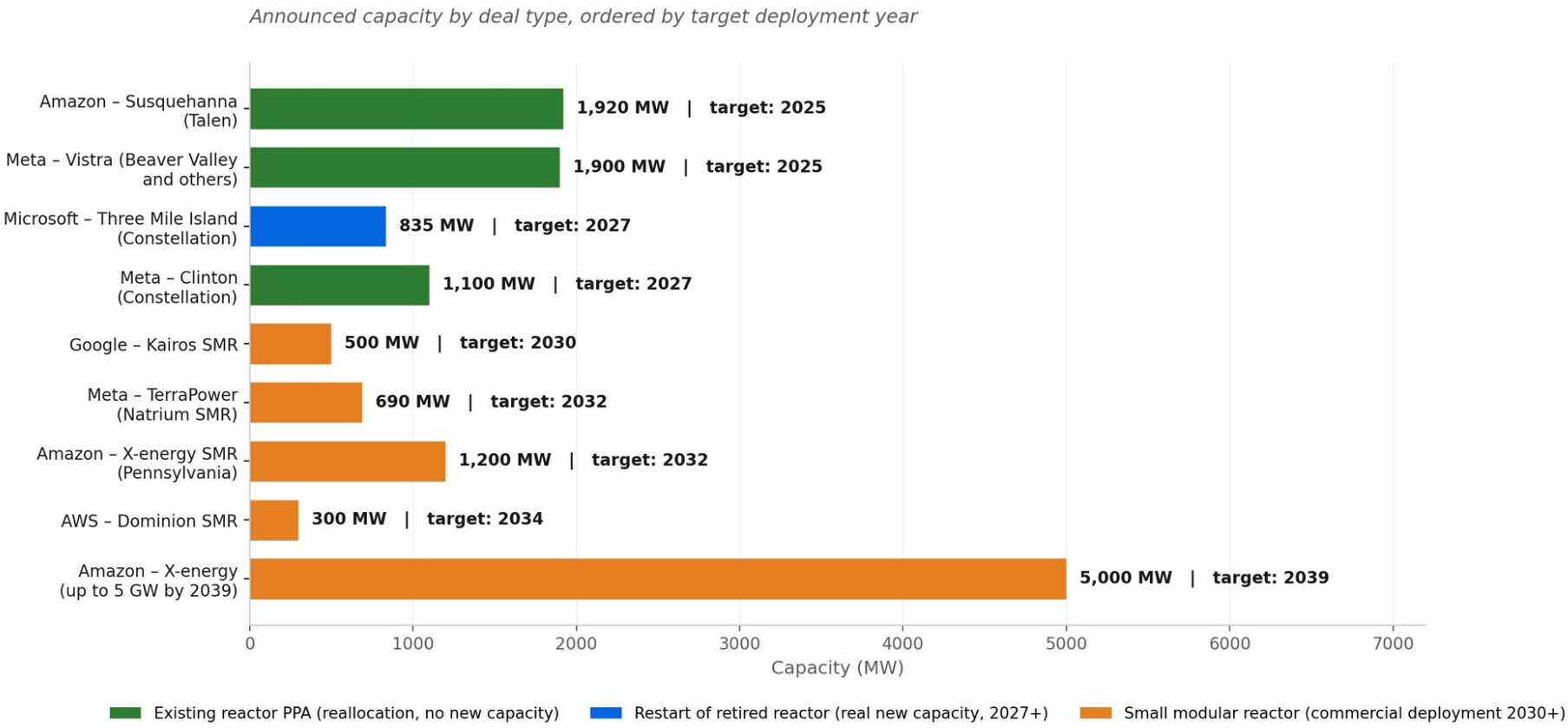
This is the most visible part of a much larger pattern. Hyperscalers have committed to over 28 gigawatts of nuclear capacity in the past 18 months, more than the United States has financed in the previous decade.
The deals on the table
Microsoft anchored the trend with Three Mile Island. The other three followed quickly.
Amazon signed a 1,920 megawatt agreement with Talen Energy at the Susquehanna nuclear plant in Pennsylvania, running through 2042, and committed $500 million to X-energy with the option for up to 5 gigawatts of small modular reactor capacity by 2039. AWS has separately partnered with Dominion Energy in Virginia on a 300 megawatt SMR project, with site selection expected this year.
Google signed a 500 megawatt agreement with Kairos Power in October 2024 for a fleet of small modular reactors, with first power targeted in 2030 and full deployment by 2035. The deal was the first hyperscaler corporate purchase of SMR power in history.
Meta has gone furthest. In June 2025, the company signed a 20-year deal with Constellation for the existing Clinton nuclear station in Illinois, around 1,100 megawatts. In December 2025, it added a 6.6 gigawatt nuclear package combining Vistra's Beaver Valley reactors, two TerraPower units of 690 megawatts targeting 2032, and Oklo SMRs. Meta has also published a 4 gigawatt request for proposals for additional new nuclear capacity.
The IIEA in Dublin, the Brookings Institute, and Wood Mackenzie have all noted the same structural fact: the marginal investor in new American nuclear is no longer the utility regulator or the federal government. It is the cloud procurement team.
What gets built and what doesn't
The optimistic case stops at the deal announcements. The operational reality is more granular.
Restarts of existing reactors are the only category that delivers electrons before 2030. Three Mile Island in 2027, Palisades in Michigan in 2026, Duane Arnold in Iowa in evaluation. The combined capacity of all viable US restarts is around 4 gigawatts. That is real and material, but it is roughly two days of new hyperscaler capex.
Existing operating reactors signing PPAs with hyperscalers do not add capacity to the system. They reallocate it. When Microsoft buys all of Three Mile Island and Meta buys all of Clinton, the homes, hospitals, and businesses that used to draw from those plants now draw from somewhere else, typically gas. Critics including the Federal Energy Regulatory Commission have flagged the reallocation problem; one of the conditions of the Talen-Amazon deal was specifically structured to address it.
Small modular reactors are the category most marketed and least delivered. The most advanced US developer, Oklo, is targeting late 2027 for its first 75 megawatt Aurora plant at Idaho National Laboratory, but the company's first NRC licensing application was rejected in 2022 and a fresh combined licence application was filed in 2025. X-energy, Kairos, NuScale, TerraPower, BWXT, Aalo and Radiant are all between three and seven years from commercial operation. Aalo Atomics expects first criticality in July 2026 and power to a co-located data centre by mid-2027. Radiant has pre-orders from Equinix for 20 microreactors. None of these are deployed at scale today.
Even the most disciplined SMR programmes face fuel-supply constraints. High-Assay Low-Enriched Uranium (HALEU), the fuel most advanced reactors require, is currently produced commercially in the United States by a single supplier, Centrus Energy, in a single facility in Piketon, Ohio, against a $3.6 billion order book. TerraPower's Natrium project has already slipped from 2028 toward 2030+ on HALEU availability alone. The fuel chokepoint sits behind the reactor chokepoint.
The optimist case, fairly stated
There is a real version of the optimistic argument. Hyperscaler nuclear procurement has moved more capital into next-generation reactor development in 18 months than the climate movement managed in three decades. The DOE Reactor Pilot Program, launched under executive orders in 2025, has selected 11 developers to build first-of-a-kind test reactors at Idaho National Laboratory by July 2026. Texas has committed $350 million through a new Advanced Nuclear Office. The NRC has been instructed to streamline licensing. Three Mile Island will return next year. The electrons will be carbon-free, the workers will be back, and Pennsylvania's GDP will grow by $16 billion over the project's life.
None of this is nothing. But none of it solves the 2026 to 2030 gap. The IEA's projection of US data centre demand growing 130% by 2030 will be met overwhelmingly by gas, not nuclear. Princeton's Jesse Jenkins puts it as add gas now, add nuclear later. The "later" is doing all the work.
What this means if you are running an AI programme inside a regulated business
For a pharma board working through a 2027 to 2030 AI deployment plan, the temptation is to read the nuclear announcements and conclude that the carbon footprint problem will resolve itself. It will not, on that timeline. Three Mile Island, Susquehanna, and Clinton are reallocations, not additions. SMRs are real but late. The grid your training run lands on in 2027 will look much like the grid that exists today, only more constrained.
The procurement implication is sharper than the carbon one. Hyperscalers are signing 20-year nuclear PPAs precisely because they know compute capacity in 2030 will be allocated through power agreements, not GPU contracts. The cloud regions with secured nuclear supply will become the regions with stable AI capacity. The regions without will become the regions where pricing whipsaws and capacity gets rationed. That is the real shape of vendor concentration risk over the second half of the decade.
For CSRD reporting, the nuclear story creates a new reporting question. Power purchase agreements signed by hyperscalers count toward their renewable matching, not yours. A pharma firm running training workloads in a Microsoft region in 2028 cannot claim the Three Mile Island electron in its own Scope 3 unless the contractual chain is explicitly structured to permit it. Most are not.