
Series · Physical Layer of AI - Part 5
Ireland is the canary
The Physical Layer of AI, Part 5 — the European test case has already been run, and the results are in.
The temptation in European boardrooms is to read the previous four articles as an American problem. That instinct is wrong, and Ireland is the proof.
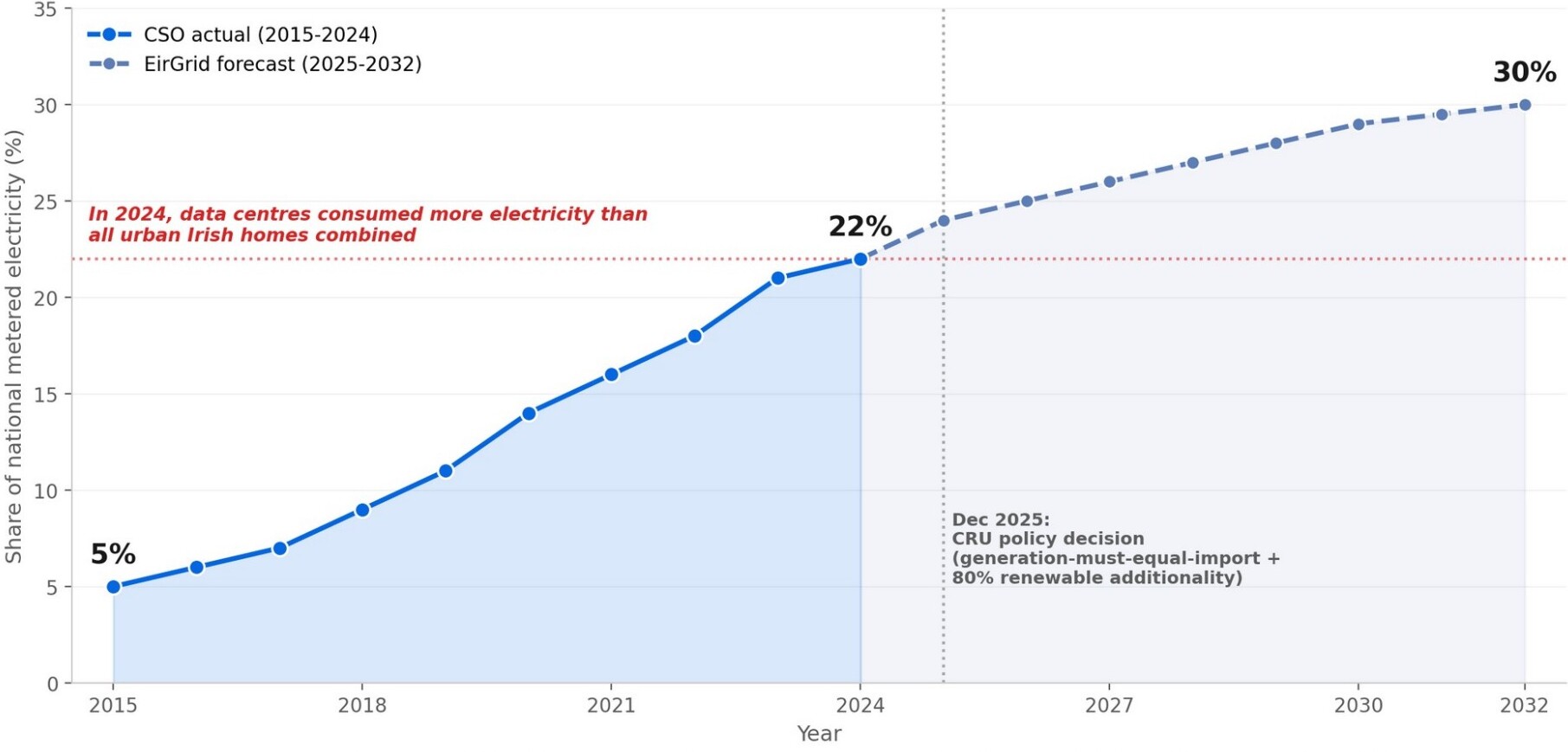
The Central Statistics Office confirmed in June 2025 that data centres consumed 22% of all metered electricity in Ireland in 2024, up from 5% a decade earlier. EirGrid forecasts that figure will reach 30% by 2032. Brookings projects close to 80% of local Dublin demand by 2030. In a country of 5.4 million people, the data centre sector now consumes more electricity than every urban home in the state combined. The European debate about how to manage this is just starting. The Irish debate has already happened, the regulator has already ruled, and the conclusions matter for every pharma or life sciences operation with EU compute footprint.
The story so far
Ireland built its data centre economy on three things: corporate tax structure, English-speaking talent, and reliable electricity. Sixteen of the world's twenty largest tech companies now have European headquarters or major data infrastructure in the country. The economic upside has been real: the broader ICT sector contributes around 18% of Irish GVA and roughly €7.3 billion in direct GDP from data centres alone.
The energy upside started to break around 2019. Data centre electricity consumption rose 460% over the following decade. By 2021, EirGrid had warned the regulator that the Greater Dublin grid could not absorb additional connections without compromising security of supply. The Commission for Regulation of Utilities, the CRU, imposed a de facto moratorium on new data centre grid connections in the Dublin region. Industry estimates suggest €6.5 billion of stalled projects accumulated. The Irish state separately commissioned around €1 billion of emergency gas generators near Dublin port and in the Midlands to keep the system stable through winter peaks. Microsoft and Google quietly shifted some workloads to the Nordics.
The political pressure ran the other way. Households watched bills rise, climate targets slip, and tech multinationals continue to win planning permission. Social Democrats, People Before Profit, and South Dublin County Council all pushed for harder limits. The campaign slogan that captured the mood was Energy for Who?
What the regulator decided
The CRU published its final decision in December 2025. It is the most consequential piece of digital infrastructure regulation any European member state has made in this cycle, and it is worth understanding clearly.
Three provisions matter most. Any new data centre connection over 1 megavolt-ampere must install on-site or proximate dispatchable generation or storage matching its full Maximum Import Capacity. That generation must participate in the Single Electricity Market and must be capable of supplying power back to the grid when called on. Second, 80% of annual data centre demand must be met by additional renewable electricity generated in the Republic of Ireland, on a six-year glide path from energisation, and that renewable capacity cannot have been previously contracted under existing state support schemes. Third, system operators retain discretion to reject connections in constrained locations, with location now a hard criterion in connection assessment.
In effect, every new hyperscale data centre in Ireland must now arrive bundled with its own power plant, its own renewables build-out, and a defensible answer to the question of where on the grid it should sit. EirGrid and ESB Networks must publish their dedicated engagement and connection process for data centre applicants by 31 March 2026, the deadline that has just passed.
This is a structural reset. The bargain has changed from "we will give you grid capacity" to "you will help us build the grid". Pinsent Masons, William Fry, Arthur Cox, and Philip Lee have all written substantive analyses arguing the same thing: the moratorium was a holding pattern, the new policy is a new model.
The European read-across
Three things follow from this for the rest of Europe.
The Cloud and AI Development Act, which the European Commission committed to propose in Q1 2026, has now been pushed to Q4 2027 under a Joint Roadmap agreed between the Parliament, Council, and Commission on 23 April 2026. The CADA explicitly targets tripling EU data centre capacity within five to seven years and prioritises sites that meet sustainability criteria. The political ambition is to land more, not fewer, of these facilities on European soil. Frankfurt is already at 42% local data centre demand, Amsterdam and Madrid are not far behind. Every one of them will face the same trilemma Ireland just resolved: security of supply, climate commitment, digital sovereignty. The Irish answer, generation-must-equal-import plus mandatory renewable additionality, is now the most likely template.
The Energy Efficiency Directive's data centre reporting obligations are accumulating real disclosure data. Article 12 of the EED, recast in 2023, requires data centres of 500 kilowatts and above to report PUE, WUE, energy reuse factor, renewable energy factor, total energy consumption, total water input, and waste heat reused, into a European database. The third reporting cycle closes May 2026, and the Commission's Data Centre Energy Efficiency Package, including a rating scheme and likely minimum performance standards, is on track for adoption in Q2 2026. This is happening regardless of CADA's slippage.
CSRD reporting picks up everything underneath. For a pharma company with Irish operations and EU-region cloud workloads, the Corporate Sustainability Reporting Directive is the binding instrument that makes the local grid mix a board-level reporting question. The Scope 3 footprint of a workload running in Microsoft's Dublin region in 2027 is going to look meaningfully different from one running in the same provider's Stockholm region, and CSRD's location-based methodology will catch that difference.
What this means if you are running an AI programme inside a regulated business
For a pharma or life sciences operation in Ireland, three implications are immediate.
The cost of new compute capacity is going up. Hyperscalers building new Irish capacity must now develop dispatchable generation, contract additional Irish renewables, and navigate the SO-led location assessment. None of that is free. Those costs will land in 2027 and 2028 cloud pricing in EU-Ireland regions, and any AI deployment plan still using 2024 cost benchmarks needs revising.
The location of compute is no longer just a latency or sovereignty question. It is a sustainability question with material CSRD reporting consequences. Workloads that today happily run in Dublin may, by 2028, sit better in Frankfurt, Stockholm, or a Nordic AWS region with a cleaner grid mix. The procurement, sustainability, and IT functions that used to make these decisions in isolation now need to make them together.
The political risk is not finished. South Dublin County Council voted to block additional data centres in its county plan in 2024. The Energy for Who? coalition has not gone away. EU member states with comparable tensions, Spain and Aragón most visibly, are watching the Irish settlement to see how it holds. A pharma board planning Irish AI infrastructure investment over the next five years is making a bet on regulatory stability that the Irish state has not yet proven it can deliver.
Ireland is the canary because Ireland was first. The European debate the rest of the bloc is about to have is the one Ireland just finished.