
Layer · The full system · Compute, Data, Process
Running the system
The finale of the twelve-week series walks the whole production system, seam by seam, with the receipts the past fortnight has provided. The advantage is not the machines. It is the system that runs between them.
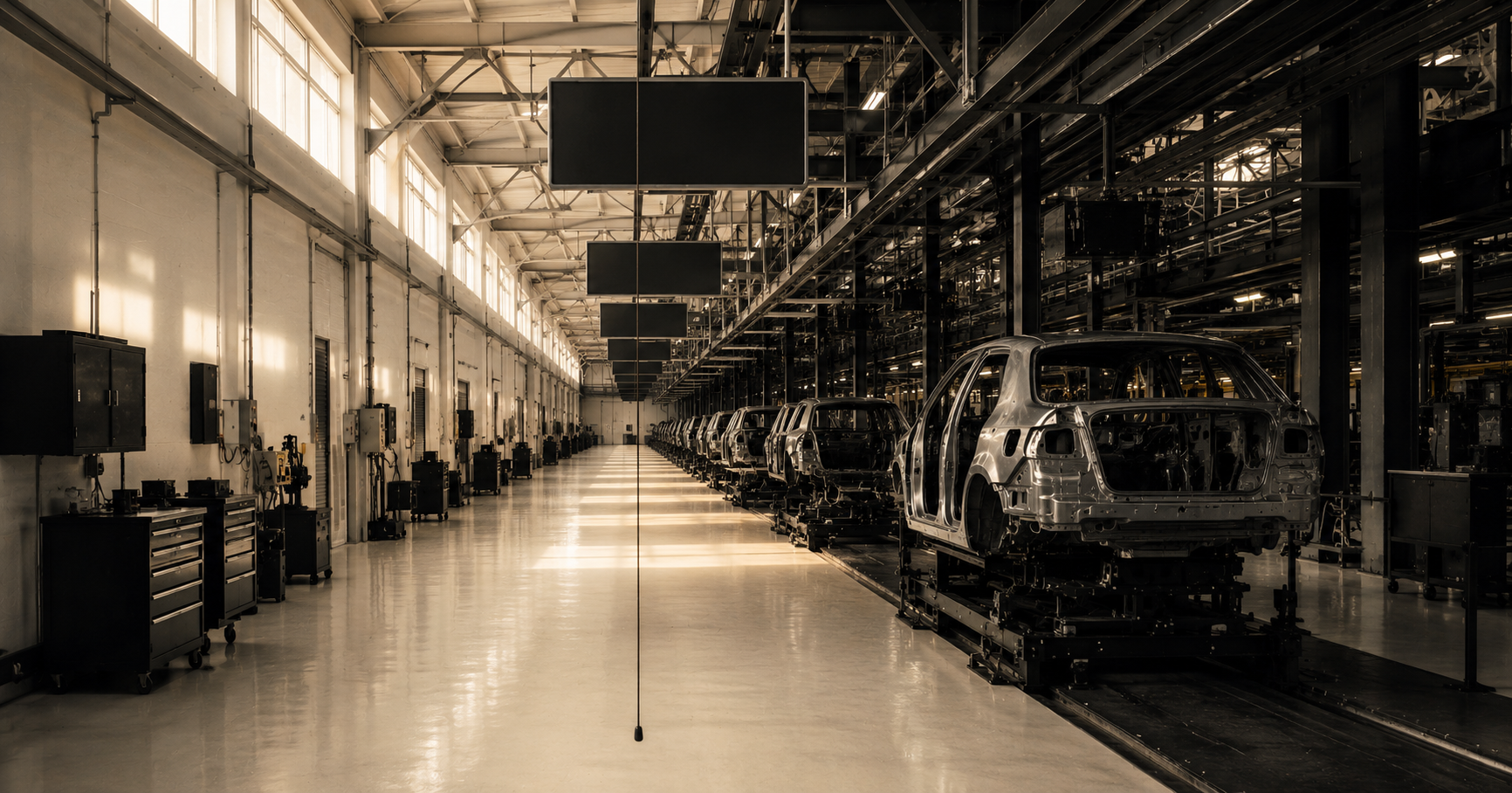
In 1985 anyone could buy the machines Toyota bought. The stamping presses came from the same suppliers, the steel from the same mills, the robots from catalogues its rivals also held. What could not be bought was the system that ran between them, the standard work, the andon cord, the assumption that the person closest to the defect had both the permission and the practice to stop the line.
General Motors got a guided tour of all of it at the NUMMI joint venture in Fremont and still took twenty years not to copy it. The machines were never the secret. The secret was that there was no secret, only a system, run every day, by people who were trusted to run it.
This series opened twelve weeks ago with a claim built on that history: the AI winners of the next decade will look more like Toyota in 1985 than a model lab in 2023. The finale walks the whole system one last time, seam by seam, with the receipts the past fortnight has provided.
The machines everyone can buy
Start where the money is, because the money has already voted. The Financial Times calculates that the foundation labs at the centre of the boom collect around 11 per cent of its $110 billion in revenue. Nearly ninety cents of every dollar lands somewhere other than the companies making the machines. That is not what a defensible layer looks like. It is what a supplier layer looks like.
The buyers have noticed. Starbucks is building its own tools to shrink a $400 million software bill. Tesla has its staff on a $200 a week AI allowance. An American open-weights model now sells at $1 per million input tokens against the $5 to $15 the closed frontier charges, and Meta's own CTO concedes the era of the monolithic model died around Llama 3. Microsoft's chief executive puts the sharpest edge on it: rent a closed model and you pay twice, once in fees, and again in the expertise your people hand over every time they correct it. When the seller warns you about the terms of sale, take notes.
This is the first seam, between Compute and everything above it, where lock-in and cost drift live. The past fortnight added a stranger exhibit. IBM lost $67 billion of market value in a single session, its worst day since at least 1972, and its chief executive's explanation was that customer budgets had not vanished but moved a layer down, into servers and memory, ahead of price rises, perhaps until 2028. Value in this stack does not disappear. It migrates between layers, and firms that cannot say which layer they are paying for cannot say what they are exposed to.
What the pipelines carry
The Data layer got its own confession this fortnight, quietly, in a model card. The best new American open-weights model was post-trained partly on synthetic output from a Chinese model, which was itself trained on scraped human work. Model-to-model inheritance is no longer a hypothesis about the future of training data. It is documented practice at the frontier.
Downstream, the contamination is less polite. An Irish-language watchdog found millions of music tracks swept into training sets without consent. Recruiters now screen AI-written CVs with AI screeners, while prompt injections hide in the CVs themselves. The lesson of the second seam is the lesson of incoming inspection anywhere: a production system that does not check what arrives at the loading dock will ship whatever arrived. Provenance is not a compliance exercise. It is an operational discipline, and it has to be run, not declared.
Where the work actually happens
Then the layer this series has cared about most. Rockwell surveyed 1,560 manufacturers across 17 countries and found that 93 per cent run a manufacturing execution system and only 23 per cent have fully integrated it. Read that again as a sentence about AI, because it is one. Everyone owns the machines. Almost nobody runs the system.
Ford is what running the system looks like. Over three years it hired 350 veteran engineers, it calls them gray beards, to mentor younger staff and to rework AI tools that had been built without engineering context. Last month it topped J.D. Power's Initial Quality Study for the first time since 2010, with roughly $1 billion in expected warranty savings this year. Map it onto the three Ps and the story tells itself. Permission: the people who knew the line were given authority over the tools, not a survey about them. Practice: the knowledge moved through mentoring and daily work, not a training module. Proof: the result surfaced in the warranty line, a number finance already trusts, not in a dashboard built to flatter the programme.
The same fortnight supplied the cautionary mirror. An economist at Brown turned his final into a closed-book exam and watched the scores of 56 of his 59 students collapse. Practice decays wherever the tool does the work and no loop captures the judgement. That is as true of a claims team as a classroom, and it is why Practice sits inside the Process layer as a P of its own rather than a line in a rollout plan.
The seam above the top layer
Above Process sits the seam this series has argued is the most expensive of all, where output meets the board and the regulator. It has just acquired its first market-wide number. The Artificial Intelligence Underwriting Company, with researchers from Anthropic and OpenAI, finds that more than 90 per cent of insurers' AI exposure sits silent inside conventional policies, neither included nor excluded, and largely unpriced. The response has begun: generative AI exclusions are entering standard liability wording, which moves the risk onto the firms using the technology, whether or not they have priced it either.
The regulators are converging on the same point from the other side. Demis Hassabis wants a FINRA-style body vetting frontier models 30 days before release, operational this year. And the FDA has cleared the first patient-facing medical chatbot as a device, on one condition worth noticing: the clinician still signs off. The machine may speak. A named human remains accountable. When the underwriters and the regulators arrive at the same seam in the same fortnight, believe the seam.
Running the system
A production system is judged at its weakest point, not its most impressive one. The Wall Street Journal notes that Taiwan holds less than three weeks of fuel in reserve, and that a fab which browns out takes 90 days to restart. Every AI strategy on earth quietly assumes that island stays lit. Systems thinking does not stop at your own walls.
So end where the series began. Toyota did not win the 1980s with a better engine, and everyone could see the engine. The models are the engines of this decade, visible, licensable, increasingly interchangeable, and priced by the market accordingly. Brightbeam's chief executive put it plainly on a podcast this month: there may be a valuation bubble, but there is no utility bubble. Even Mark Zuckerberg, mid-bet on general superintelligence, concedes that narrow models built on proprietary data keep beating the ever-larger general ones. The capability is abundant. The advantage is not in the capability.
The advantage is a system: Compute bought like a component, Data inspected like a delivery, and a Process layer where Permission, Practice and Proof are run daily, under an accountability seam that is watched rather than discovered. None of that can be licensed, which is precisely why it will be worth having.
This argument now becomes a book, AI is a production system, and the writing starts Monday. If one seam in your own operation kept coming to mind over these twelve weeks, that is the chapter to hold me to.
Sources
- Financial Times, foundation model revenue share: https://www.ft.com/content/7bff5ad3-a7dc-4641-be97-7f383446ff75
- Fortune, Starbucks' $400m software bill, 9 July 2026: https://fortune.com/2026/07/09/starbucks-to-use-ai-to-replace-microsoft-ibm-software/
- Electrek, Tesla's AI spending cap, 2 July 2026: https://electrek.co/2026/07/02/tesla-caps-employee-ai-spending-200-week/
- Fortune, Ford's 350 gray beard engineers, 29 June 2026: https://fortune.com/2026/06/29/ford-ai-hired-human-workers-gray-beards-automation/
- J.D. Power, 2026 US Initial Quality Study, 25 June 2026: https://www.jdpower.com/business/press-releases/2026-us-initial-quality-study-pr
- Rockwell Automation, Scaling MES Across the Enterprise, 14 July 2026: https://www.prnewswire.com/news-releases/93-of-manufacturers-have-mes-but-only-23-have-fully-integrated-it-new-rockwell-automation-report-finds-302824247.html
- TechRadar, Satya Nadella on paying for intelligence twice, July 2026: https://www.techradar.com/pro/you-essentially-pay-for-intelligence-twice-once-with-money-and-again-with-something-even-more-valuable-microsoft-ceo-satya-nadella-warns-ai-users-not-to-give-away-too-much
- AIUC, Underwriting the Agent Economy, July 2026: https://www.underwriting-agents.com/
- Verisk generative AI liability exclusions, Independent Agent: https://www.independentagent.com/vu_resource/verisk-to-roll-out-new-general-liability-exclusions-for-generative-ai-exposures/
- Demis Hassabis, proposed AI oversight body: https://x.com/demishassabis/status/2076957440109625718
- Big Technology, Andrew Bosworth interview: https://www.bigtechnology.com/p/metas-path-to-ai-relevance-according
- a16z podcast, Mark Zuckerberg and Priscilla Chan: https://a16z.simplecast.com/episodes/mark-zuckerberg-priscilla-chan-how-ai-will-help-cure-disease-J_rYFGCM
- Brightbeam, SNI Week 28: https://www.brightbeam.com/post/sni-week-28